Research
About Our Research

Team Science at a Global Scale
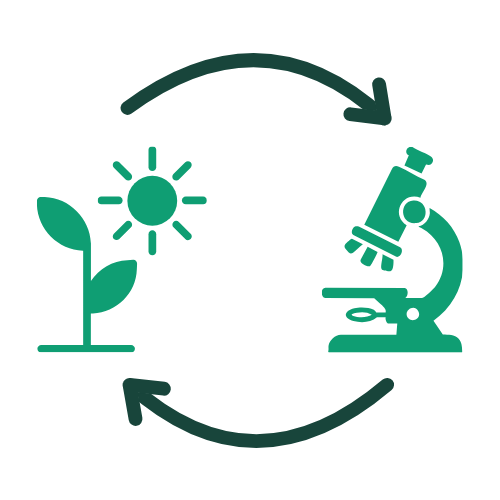
Field to Lab to Field Paradigm
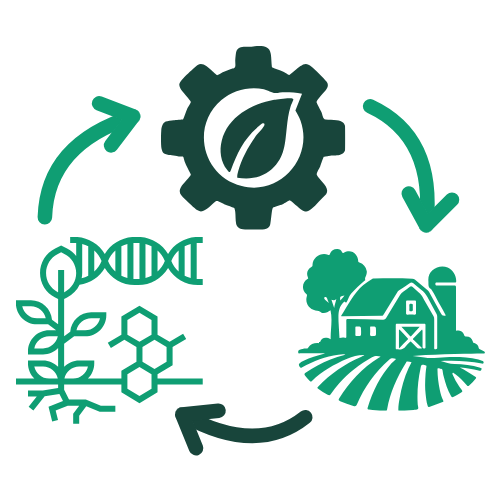
Fundamental-Translational-Applied Cycle
The Plant Resilience Institute, or PRI, at Michigan State University is a globally renowned laboratory and field research center for plant resilience.
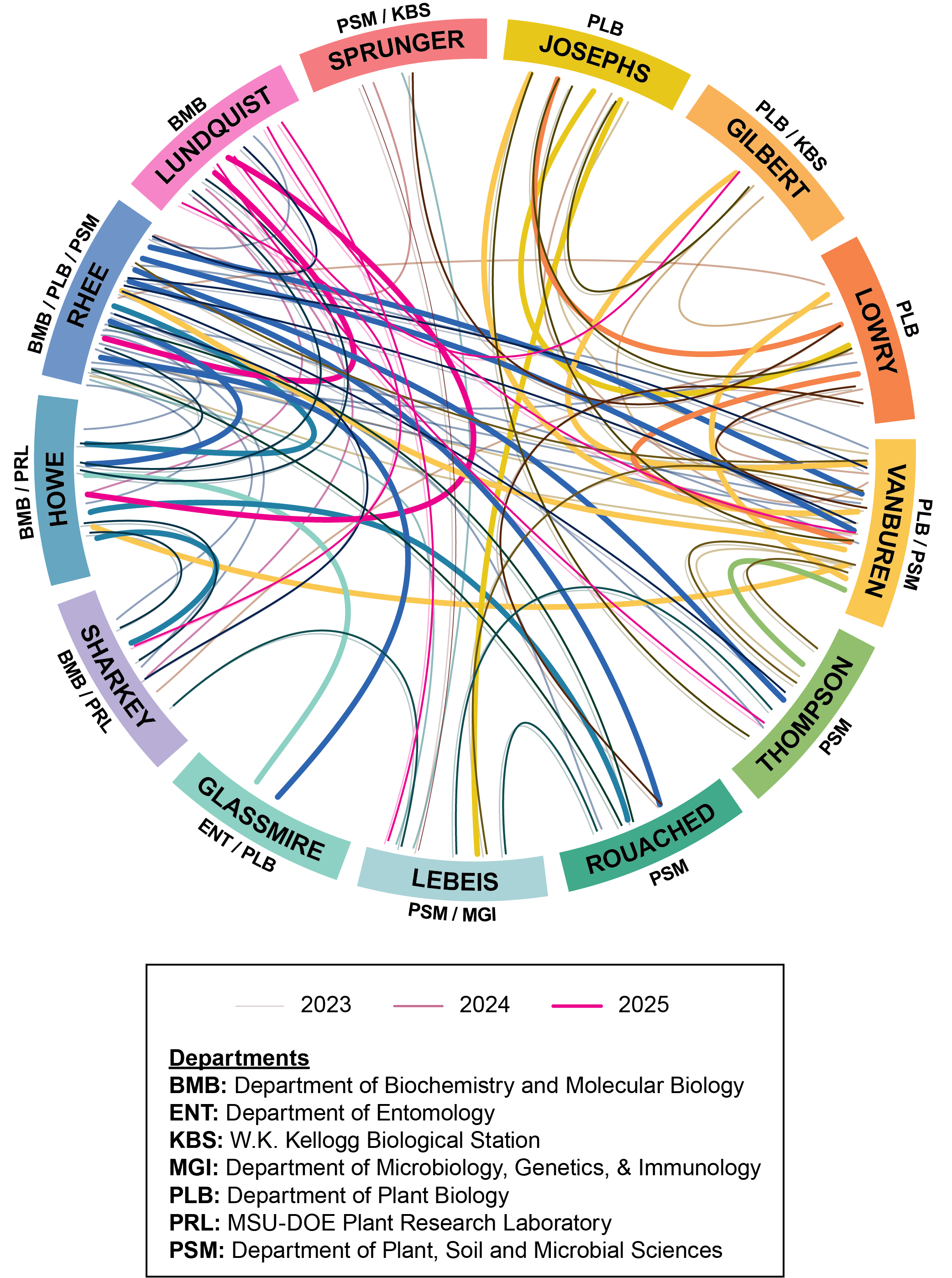
As a Center of Excellence, PRI connects leading plant researchers and eminent interdisciplinary labs to address the challenges that climate change poses to food production and crop resilience. By focusing on convergent science, PRI provides the resources and platform for groundbreaking collaborations. The PRI faculty come from colleges, departments, and institutions across MSU, including:
- College of Agriculture and Natural Resources
- College of Natural Science
- Department of Biochemistry and Molecular Biology (BMB)
- Department of Entomology (ENT)
- Department of Microbiology, Genetics, & Immunology (MGI)
- Department of Plant Biology (PLB)
- Department of Plant, Soil and Microbial Sciences (PSM)
- MSU-DOE Plant Research Laboratory (PRL)
- W.K. Kellogg Biological Station (KBS)
PRI’s research excellence extends from basic science to agricultural improvements, integrating molecular, genetic, physiological, ecological, and computational approaches to understand the complex mechanisms of how plants respond to, resist, and tolerate environmental stresses. Emphasis is placed on mechanistic studies of stress tolerance, plant-microbe interactions, regulatory metabolites, and genotype x environment interactions. This research combines insights from both natural biological systems and crop species to inform agricultural improvement, environmental sustainability, and conservation goals. PRI also broadly uses non-model plant systems, allowing scientists to research critical biological questions that would not be possible to answer using a narrower range of study systems.
Impact by Numbers
600+
10
96,700+
See more on the PRI Google Scholar profile.
Flagship Research Projects
In 2025, the PRI faculty identified three flagship areas of research as part of a bold, multi-phase vision covering the next decade to address major agricultural challenges posed by climate change. Each unique initiative synergizes the collective knowledge, interest, and expertise of PRI labs and builds organically from their ongoing areas of excellence in research. Together, the flagship projects aim to make PRI a global hub for climate-resilient agriculture and systems-level plant science.
EWASPR
The Environmental Wide Association Study for Plant Resilience (EWASPR) project aims to identify environmental variables that causally shape plant growth, yield, and stress response. EWASPR builds on genotype-by-environment efforts but shifts the experimental emphasis to intensively study a small number of strategically chosen field sites using diverse, controlled environmental treatments. By maximizing environmental variation per site and pairing dense sensing with intentional design, this approach increases power to link environmental factors with plant outcomes to transform agriculture in a changing environment.
GLACIERS
The Great Lakes Advanced Climate Impact & Experimental Research Station (GLACIERS) is designed to investigate how projected 2050-2100 climate scenarios will affect plant resilience, agroecosystem function, and the genetic and environmental bases of adaptation by bridging high-resolution climate manipulation with open-field conditions. This initiative will replicate future extreme climatic scenarios in the Midwest by constructing infrastructure like rainout shelters, heating arrays, and flooding platforms for controlled stress experiments with the goal of identifying resilience traits across diverse food crops.
PRIME
The Plant Resilience-Inducing Metabolite Effectors (PRIME) initiative seeks to identify a new class of regulatory metabolites and their nuclear signaling mechanisms that govern plant resilience. The project integrates bioinformatics, molecular genetics, protein structural prediction, and experimental validation to investigate the metabolites’ roles in gene regulation and stress response, positioning PRI as a global leader in this previously unexplored field.
Center-Level Research Initiatives
PRI continues to expand its impact on plant resilience research by coordinating and advancing large-scale, center-level research initiatives aimed at addressing global challenges in plant science and agricultural sustainability. PRI faculty play key leadership roles in several major research centers, including:
C-SPIRIT
C-SPIRIT, or the Center for Sustainable Plant Innovation and Resilience through International
Teamwork, is an NSF Global Center with the mission to discover bioactive compounds that enhance
plant and soil health while engaging industry partners and stakeholders to co-develop
technology, promote sustainability, and build public trust. C-SPIRIT establishes a
collaborative framework across five countries – the U.S., U.K., Canada, Japan, and
Republic of Korea – to pool resources, expertise, and technologies for solving agricultural
challenges.
GLBRC
The Great Lakes Bioenergy Research Center (GLBRC) is a DOE-funded Bioenergy Research Center led by the University of Wisconsin–Madison in collaboration with MSU and other partners to create biofuels and bioproducts that are economically viable and environmentally sustainable.
KBS LTAR and LTER
The W.K. Kellogg Biological Station (KBS) Long-Term Agroecosystem Research (LTAR) is part of the USDA's LTAR network, established to develop national, long-term strategies for sustainable agricultural production. KBS LTAR research informs the design of cropping systems that balance future productivity needs with enhanced environmental performance and benefits to farmers and society.
The KBS Long-Term Ecological Research (LTER) is part of the NSF LTER Network to advance sustainable and resilient agricultural ecosystems through integration of long-term scientific research, education, and engagement with stakeholders.
PCA
Plant Cell Atlas (PCA) is an NSF-funded grant to create a community resource that maps cellular and subcellular plant protein localization patterns, track the dynamic interactions between proteins, identify the molecular components of cellular substructures, discern complete states and transitions of specialized cell types, and integrate these disparate data points in order to generate testable models of cellular function. The PCA initiative includes plant science leaders from imaging, proteomics, genomics, nanotechnology, and data science from across the nation.
PMN
Plant Metabolic Network (PMN) is an NSF and DOE grant that aims to bring together biochemical pathway databases and research communities focused on plant metabolism. At the center of the PMN is PlantCyc, a public reference database containing pathways and their catalytic enzymes, compounds, and genes from many plant species.
SYNCORNET
SYNCORNET is a multi-institutional research project funded by ARPA-E focused on engineering synchronized nitrogen efficiency traits in corn agriculture. SYNCORNET will systemically address agricultural inefficiencies in corn across the entire growing season through precision trait engineering, creating more sustainable and nitrogen-efficient corn agroecosystems.
WALII
WALII, or the Water and Life Interface Institute, is an NSF grant that operates as a virtual research institute bringing together labs across the U.S. to study how life continues without water from the molecular level up to evolutionary levels. WALII members seek to understand the methods used to survive desiccation and rehydration and whether or not these strategies are similar for all organisms.