Derek Denney accepts the Cooper Award at ESA 2026
Plant Resilience Institute Postdoctoral Fellow Derek Denney traveled to Salt Lake City, Utah, to accept the W.S. Cooper Award at the Ecological Society of America (ESA) 2026 Annual Meeting.
The Cooper Award honors the authors of outstanding publications in the field of geobotany, physiographic ecology, plant succession, or the distribution of plants along environmental gradients. Denney is a co-author on one of two studies honored this year, “Adaptation and gene flow are insufficient to rescue a montane plant under climate change,” by Anderson et al., published in Science (2025).
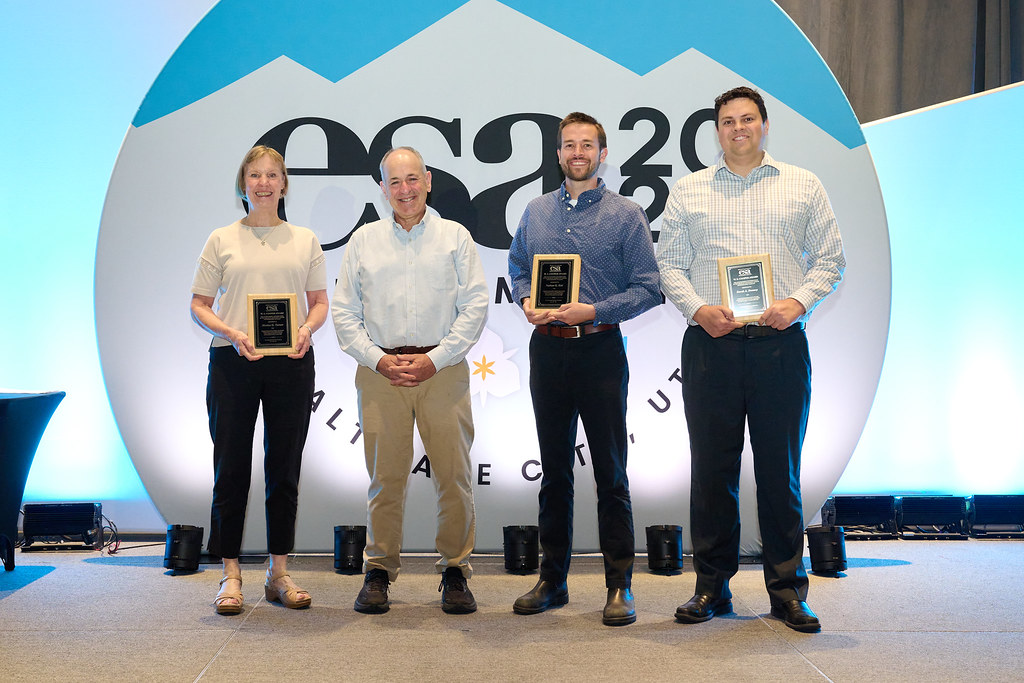
Denney accepted the award on behalf of his former Ph.D. advisor and lead author on the study, Dr. Jill Anderson, and attended the awards ceremony at the ESA 2026 Annual Meeting with a travel grant provided by the Plant Resilience Institute.
In their award-winning publication, Anderson et al. collected data on the perennial plant Boechera stricta to test how evolutionary processes shape plant persistence under climate change. Using more than 100,000 seeds and seedlings from 115 populations transplanted across five sites in the Rocky Mountains, the team modeled fitness under current and projected climatic conditions. Their results predict a decline in adaptive potential and insufficient gene flow to keep up with climate change, indicating that assisted migration may be necessary for persistence.